Home › B-Movies & Drive-In Nights
What Is Grindhouse? The Theaters Behind the Name, and the Movies They Showed
Grindhouse started as a kind of cheap, nonstop downtown movie theater before it became a label for lurid low-budget films. Here's where the word came from, what the theaters showed and why they disappeared.
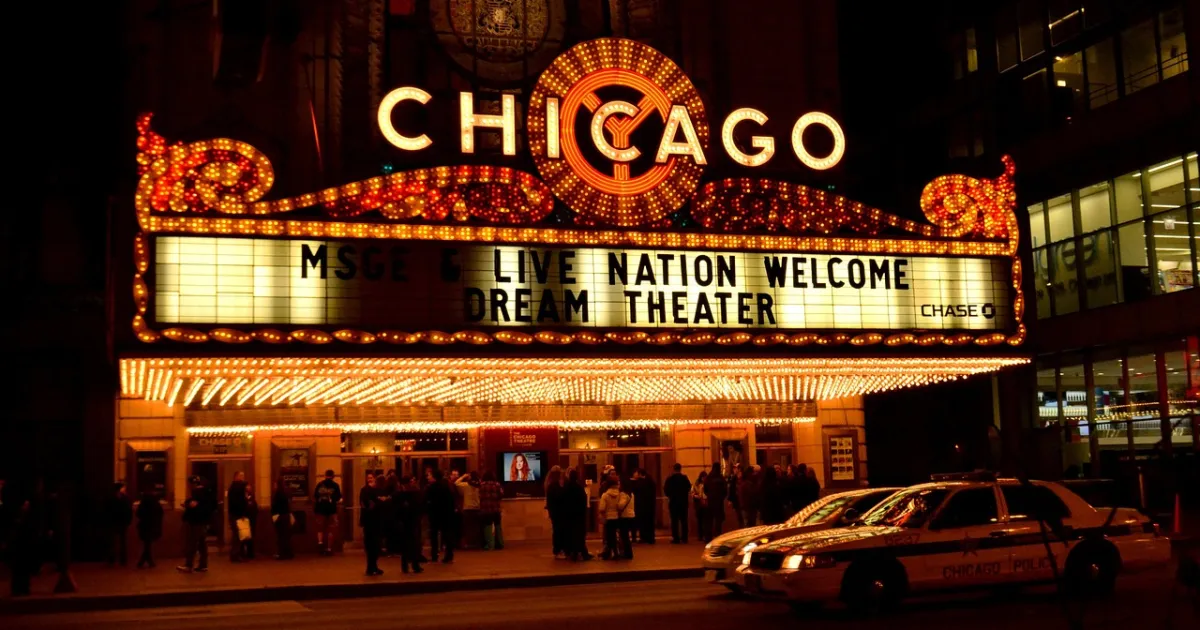
Grindhouse is an American term for a cheap, nonstop movie theater, usually downtown, that ran low-budget horror, splatter, foreign and exploitation films one after another. So the honest answer to "what is grindhouse" starts with a building, not a genre. The word later stuck to the films themselves. Today "grindhouse" mostly describes a look and an attitude: rough, lurid, low-budget, made for an audience that wanted sex, violence or something strange for the price of a ticket.
Where the word "grindhouse" came from
According to film historian David Church, the name comes from the "grind policy," a way of programming theaters that dates to the early 1920s. A grind theater ran films continuously at cut-rate prices, and the ticket price typically rose as the day went on. Most big urban theaters of the period worked differently. They were often studio-owned, ran fewer shows a day, and charged different prices for different sections of seats.
Church traces the first use of "grind house" to a 1923 article in Variety. That paper may have borrowed "grind" from contemporary slang for the barkers who stood outside and talked passersby into coming in. Dictionary.com dates the word to 1920–25 but gives a different origin. It mixes "grind" in the sense of cranking an early projector by hand with "grind" as in a cheap film a studio grinds out. The sources do not agree, and no one origin is settled.
The burlesque mix-up
You will often read that the word started with the burlesque houses on New York's 42nd Street, where "bump and grind" dancing was the draw. Some film-education sites repeat this as fact. Church calls it an error, encouraged by the fact that grind theaters sat close to burlesque. A character in Lady of Burlesque (1943) does call a 42nd Street burlesque theater a "grindhouse," and Dictionary.com still lists "a burlesque house" as one meaning. The movie-theater sense, though, is the primary definition in the Oxford English Dictionary.
What made a theater a grindhouse
The Oxford definition, as Church summarizes it, comes down to three things:
- a variety of films shown in continuous succession
- low admission prices
- films that were often of poor quality or low artistic merit
Double bills, triple bills and all-night programs on a single admission were common, which meant some patrons stayed for hours. That set grindhouses apart from discount and neighborhood theaters, which also ran cheap shows but mostly played second-run films that had already gone wide. A grindhouse was typically urban, and much of its program was first-run material of low merit. Later-run Hollywood films played these screens too. But because the audience was seen as lower class, the theaters came to be thought of as disreputable places showing disreputable movies, whatever was actually on the marquee.
The famous strips were New York's Times Square and 42nd Street, Los Angeles's Broadway and Hollywood Boulevard, and San Francisco's Market Street. The term also crossed the Atlantic. Collins, a British dictionary, defines a grindhouse as a cinema specializing in violent or exploitative films, such as martial arts movies from Japan and Hong Kong.
| How the word is used | What it means | Where it comes from |
|---|---|---|
| A grindhouse (noun) | A cheap theater showing films continuously, day and much of the night | Grind-policy theaters, from the 1920s |
| A grindhouse movie | A low-budget film of the kind those theaters played, often exploitation or B-movie fare | The programming of these theaters |
| Grindhouse style (adjective) | A deliberately cheap, lurid look in a newer film | Later homages and critics' shorthand |
What is a grindhouse movie?
A grindhouse movie is a low-budget film of the kind these theaters ran, or one made to feel like it. Films shot for and screened at grindhouses usually carry heavy doses of sex, violence or bizarre subject matter. One staple was the "roughie," a sexploitation film mixing sex, violence and sadism. Budgets were small, and poor print quality was common. Film-school explainers list the usual traits: rough editing, cheap effects, inexperienced actors and taboo subjects.
The term overlaps heavily with exploitation film, but they are not the same thing. "Exploitation" describes how a film was sold. "Grindhouse" originally described where it played. For the subgenres themselves, from sexploitation to biker pictures, see our guide to exploitation films and the grindhouse era. Grindhouse programs also shared a lot of DNA with the cheap second features covered in what is a B-movie.
Titles that explainers keep returning to as textbook grindhouse fare include:
- The Texas Chain Saw Massacre (1974), usually cited for its brutality and threadbare look
- Death Race 2000 (1975), dystopian science fiction built around violent car races
- I Spit on Your Grave (1978), a controversial revenge film
Critics never agreed on this material. Opinions varied, yet many grindhouse films later picked up critical praise and devoted audiences. That is the same afterlife described in how movies earn a cult following.
Why grindhouses boomed in the 1970s and then vanished
Many of these theaters were single-screen houses built during the movie boom of the 1930s. Television ate into their audience. Then, in the mid to late 1960s, white flight and urban decay hollowed out the older downtowns around them. Owners had to close or show something television could not. In the 1970s, many turned to exploitation programming: adult films, sleaze, slasher horror and dubbed martial arts films from Hong Kong.
The end came from the living room again. By the mid-1980s, home video and cable movie channels were making the grindhouse obsolete. By the end of that decade, these theaters had disappeared from Times Square, Los Angeles's Broadway and Hollywood Boulevard, and San Francisco's Market Street. Accounts say that by the mid-1990s they were all but gone from the United States, though that later date is less well documented.
Grindhouse (2007) and the grindhouse look today
The word got a wide new audience through Grindhouse (2007), a double feature pairing Robert Rodriguez's Planet Terror with Quentin Tarantino's Death Proof. It revived the old double-bill format in one package of 191 minutes, and Wikidata also lists Edgar Wright, Rob Zombie and Eli Roth among its directors. Its box office was about $25.4 million against a reported cost of $67 million, figures Wikidata takes from Box Office Mojo.
Since then, "grindhouse" has worked mostly as an adjective. Critics use it for newer films with a cheap, lurid look or blunt dialogue, or simply for anything cheap and gleefully excessive. Streaming catalogs change month to month, so check a title's current availability on a service's own search or a listings tool before planning a double bill.